
The Secret to Getting Your Voice Heard in Government

“Practical strategies for ensuring your concerns reach policymakers.”

Great — here are some practical tips to increase the chances that your message makes it past the sorting stage and into the policymakers’ daily briefing or staff reports:

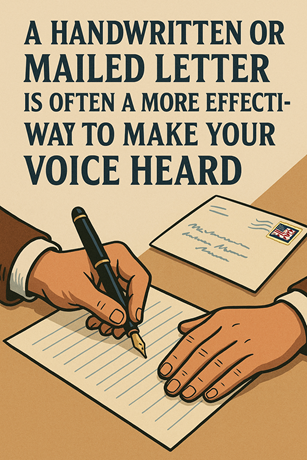
“A handwritten or mailed letter is often a more effective way to make your voice heard. The White House receives 40,000–50,000 emails every day, most of which are reduced to summaries and trend reports. By contrast, a handful of letters—perhaps 10—are chosen for the policymakers’ daily briefing folder.”


1. Be Personal, Not Generic

  • Share a personal story or experience that connects to a larger issue.
  • Instead of just saying “I oppose higher taxes,” explain how a specific policy impacts you, your family, or your community.
  • Staff look for letters that put a human face on a policy.

2. Keep It Clear and Focused

  • Stick to one main issue per message.
  • Use simple, direct language instead of long explanations.
  • Avoid clutter — a focused story or argument is easier for staff to pull and summarize.

3. Connect to National Values

  • Relating your concern to American ideals (freedom, fairness, opportunity, the Constitution, the Bible if appropriate for you) makes it resonate more.
  • Example: “I believe protecting the Second Amendment is part of protecting the freedoms our nation was founded upon.”

4. Show Respect and Sincerity

  • Avoid insults, sarcasm, or angry rants — those are less likely to be passed up the chain.
  • A firm but respectful tone has a greater chance of being taken seriously.

5. Be Timely

  • Reference a current event, bill, or policy debate.
  • Timely messages are more likely to be chosen because they connect with what the President and staff are already discussing that day.

6. Make It Shareable

  • Write in a way that makes your message quotable.
  • Short, memorable sentences often stand out.
  • Example: “When government spending grows, my family’s grocery budget shrinks.”

7. Send It Through the Right Channel

  • Use the official White House contact form (https://www.whitehouse.gov/contact/) — this is the fastest way to get into the system.
  • For especially important issues, send both an online message and a physical letter (mailed letters often carry extra weight because fewer people take the time to write them).

Pro Tip: If you’re writing on behalf of an organization or church, note how many people you represent. Saying “I’m writing on behalf of 200 families in our congregation” gives the letter more influence than just speaking as one individual.


Let me know what you think below


Copyright Notice © 2025 Cecil Wayne Thorn Permission is hereby granted, free of charge, to any person obtaining a copy of this work authored by Cecil Wayne Thorn, to distribute, display, and reproduce the work, in its entirety, including verbatim copies, provided that no fee is charged for the copies or distribution. This permission is granted for non-commercial distribution only.

Where is the USA in the Cycle of Nations

Introduction

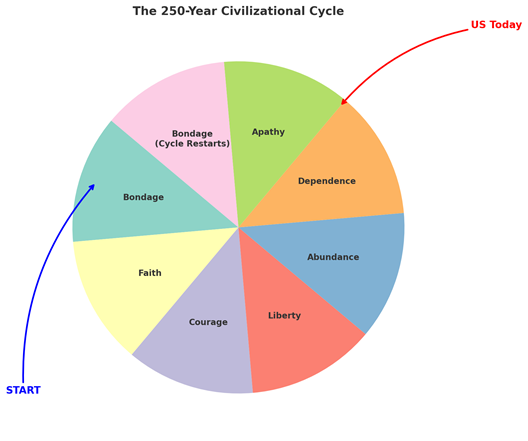
Throughout history, great civilizations have risen to power, enjoyed prosperity, and then declined. Many scholars describe this as the Cycle of Nations, a repeating pattern that shows how societies move through stages: from bondage to faith, from faith to courage, from courage to liberty, from liberty to abundance, from abundance to dependence, from dependence to apathy, and finally from apathy back into bondage.

The United States, now approaching 250 years since its founding in 1776, has followed much of this same pattern. Born out of bondage under British rule, the nation embraced faith and courage, secured liberty, and grew into a land of abundance. Yet, history warns that abundance often breeds dependence and apathy, weakening the values that once sustained freedom. Many believe America today sits dangerously between these latter stages, facing a choice: drift further toward bondage, or renew its foundation of faith and courage to restore liberty.


1. Bondage → Faith

  • Start of America (pre-1776): Colonists under British rule, longing for freedom. Out of bondage came a turn to God and faith in a higher cause.

2. Faith → Courage

  • Revolutionary Era (1776–early 1800s): Faith gave rise to courage. Men and women risked everything for independence and self-governance.

3. Courage → Liberty

  • Founding & Expansion (1800s): Liberty flourished. The Constitution, Bill of Rights, and westward growth embodied a people willing to defend their freedoms.

4. Liberty → Abundance

  • Industrial Revolution to mid-1900s: America reached abundance—economic power, scientific progress, and global leadership after WWII.

5. Abundance → Dependence

  • Late 20th Century: Prosperity created dependence on government programs, entitlements, debt, and consumer comforts.

6. Dependence → Apathy

  • Today (2000s–2020s): Many analysts say the U.S. is between dependence and apathy:
    • Growing reliance on government and systems.
    • Declining civic involvement.
    • Rising political polarization.
    • Comfort and distraction taking priority over responsibility.

7. Apathy → Bondage?

  • If the cycle continues, apathy leads to loss of freedoms—bondage. Not necessarily chains, but bondage to debt, surveillance, elite control, or external powers.

Conclusion:

The U.S. appears to be standing at a critical juncture in the Cycle of Nations, somewhere between Dependence and Apathy. In many ways, the nation’s wealth and abundance have created comfort, but also complacency. Heavy reliance on government systems, rising national debt, and a culture of entitlement reveal growing dependence. At the same time, widespread disillusionment with politics, declining civic involvement, and a pursuit of personal ease over collective responsibility reflect apathy. These forces together weaken the very fabric that once secured America’s liberty.

History warns that when apathy takes hold, societies inevitably slide toward bondage—not always chains of iron, but bondage through loss of freedoms, economic collapse, or rule by elites. Yet, this path is not inevitable. The cycle can be broken if people return to the principles that first brought freedom: faith that grounds moral conviction and courage that acts boldly in the face of challenges. Renewal will require personal responsibility, spiritual awakening, and a willingness to sacrifice for the good of future generations. Without such a shift, the nation risks repeating the downward spiral seen in past empires. With it, however, America may yet rise again to reclaim the liberty and strength that marked its beginning.


Call to Action

The cycle of nations is not fate; it is a warning. America’s future does not have to be written in decline. The turning point will come when ordinary citizens choose to rise above dependence and apathy, and instead embrace the values that once gave birth to liberty.

  • Renew Faith: Return to the spiritual and moral foundations that shaped the nation, acknowledging that freedom without virtue cannot last.
  • Choose Courage: Stand boldly for truth, justice, and righteousness, even when it is unpopular or costly.
  • Live Responsibility: Take ownership of your family, community, and civic life instead of waiting for institutions to carry the burden.
  • Guard Liberty: Be vigilant in defending freedoms, remembering they can be lost far more quickly than they were won.

If America’s citizens embrace these commitments, the cycle can bend back toward liberty and strength. If not, history suggests the outcome: bondage. The choice belongs not to governments or leaders alone, but to every individual who calls this nation home.


Let me know what you think below


Copyright Notice © 2025 Cecil Wayne Thorn Permission is hereby granted, free of charge, to any person obtaining a copy of this work authored by Cecil Wayne Thorn, to distribute, display, and reproduce the work, in its entirety, including verbatim copies, provided that no fee is charged for the copies or distribution. This permission is granted for non-commercial distribution only.