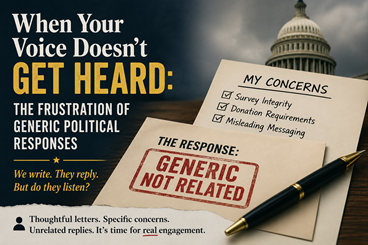
On April 16, 2026, I sent a formal letter addressing a growing concern regarding political text message campaigns—specifically those tied to surveys that appear to require a donation before responses can be submitted.
What prompted this outreach was not simply the frequency of the messages, but the structure behind them.
A survey, by definition, is meant to gather honest feedback. When access to participation is restricted—either directly or indirectly—by requiring a financial contribution, the purpose of that survey is fundamentally compromised.
The Issue: When Feedback Becomes Conditional
In recent communications, I received repeated text messages encouraging completion of a “PROFILE” survey. However, upon attempting to participate, it became clear that responses could not be submitted without making a donation.
This raises a serious concern:
Is the survey truly collecting opinions?
Or is it primarily functioning as a fundraising mechanism?
When participation is gated behind payment, it creates the impression that only those who contribute financially are allowed to have their voices heard. That is not representative engagement—it is selective feedback.
The Problem with Pressure-Based Messaging
One message stood out in particular:
“We’re GIVING UP, Cecil. We’ve texted you 7X asking you to complete your PROFILE. Did we lose you? Last chance:”
This type of language introduces unnecessary urgency and pressure. It suggests disengagement on the recipient’s part, when the real barrier is structural—responses cannot be submitted without a donation.
This approach does two things:
Misrepresents the situation
Undermines trust between organizations and the public
Why This Matters
Surveys are often used to:
Gauge public opinion
Shape messaging
Inform policy priorities
If responses are limited to those willing or able to donate, the data becomes skewed. It no longer reflects a broad base—it reflects a filtered audience.
That has real consequences:
Inaccurate representation of supporters
Reduced credibility of collected data
Erosion of public trust
A Reasonable Path Forward
In my letter, I made three clear and reasonable requests:
1. Open Access to Surveys
Survey participation should be available without requiring a financial contribution.
2. Honest and Clear Messaging
Communication should reflect reality—no implied urgency or misleading framing.
3. Transparency in Data Collection
Organizations should clearly state whether survey responses are independent from fundraising efforts.
These are not partisan concerns—they are principles of fairness and integrity.
Restoring Trust Through Transparency
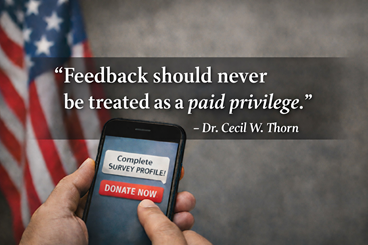
Feedback should never be treated as a paid privilege.
If organizations genuinely seek to understand the people they represent, they must ensure that every voice has equal opportunity to be heard—regardless of financial contribution.
Trust is not built through pressure. It is built through honesty, accessibility, and respect.
Final Thought
This issue goes beyond a single message or campaign. It speaks to a broader question:
Do we value input—or do we value transactions?
If the goal is meaningful engagement, then the path forward is clear: Remove barriers, speak plainly, and let people be heard.
If you’ve ever tried printing envelopes at home, you know it can feel more complicated than it should be. Between sizing, alignment, and printer settings, it’s easy to waste a few envelopes just getting things right.
The good news is you can skip most of that setup work by using a pre-formatted Google Docs template. Once it’s set up, printing #10 envelopes becomes quick and repeatable.
Here’s how to do it.
Step 1: Use a Pre-Made Google Docs Template
Instead of starting from scratch every time, create (or use) a Google Docs template that’s already sized for a standard #10 envelope (4.125″ x 9.5″).
Recently, I did something simple—but important. I sat down and wrote a letter about immigration. Not just to one person, but to multiple people in positions of power, including President Donald Trump, along with several senators and members of Congress.
I didn’t write it as a politician or an expert. I wrote it as a citizen who’s paying attention—and who’s tired of feeling like the system isn’t listening.
And that’s really the point of this post.
Why I Wrote the Letter
Immigration is one of those issues that gets talked about constantly, yet real solutions always seem just out of reach. Depending on who you ask, it’s either too strict, too loose, too broken, or too politicized to fix.
But here’s what I kept coming back to:
This is our country. These are our laws. And these people work for us.
If something isn’t working, we shouldn’t just argue about it online or shake our heads at the news. We should be speaking directly to the people who have the authority to act.
So I did.
I laid out my thoughts clearly. I spoke honestly about what I believe needs to change. And I made sure it wasn’t just noise—it was respectful, direct, and focused.
The Letter I Sent
March 24, 2026
The Honorable Donald Trump The White House 1600 Pennsylvania Avenue NW Washington, DC 20500
Dear President Trump,
I am writing to urge you to propose legislation that reclassifies illegal entry into the United States as a criminal violation rather than a civil one. Under this proposed bill, those found crossing illegally would face immediate removal, without a prolonged trial, simply upon verification of illegal entry.
The goal is clear: swift enforcement and removal to their country of origin or point of entry. I believe this will strengthen our border policy and provide clarity in enforcement.
Thank you for your consideration.
Sincerely, [Your Signature] [Your Name] [Your Phone#] [Your Email Address] [Your Street Address with zip+4]
Officials I Contacted
Donald Trump
Mike Johnson
Rick Scott
Daniel Webster
Ashley Moody
Jim Jordan
Why This Matters
It’s easy to feel like the government is something separate from us—like it’s a distant system that runs on its own, regardless of what we say or do.
But that’s not how it’s supposed to work.
We elect these people. We fund these institutions. We live with the consequences of their decisions.
So yes—they should be hearing from us. Regularly.
Not just during elections. Not just when things reach a breaking point. But consistently.
Why Writing a Letter Matters
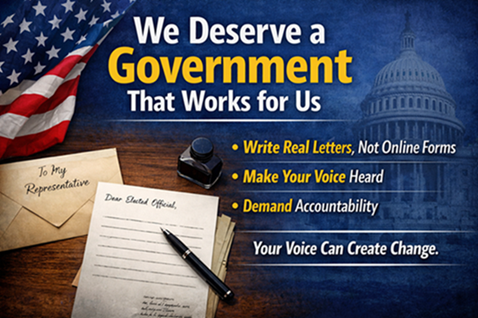
Writing a letter matters. A “Contact Us” form is easy to ignore—but a letter is deliberate, documented, and harder to dismiss. It shows effort, intention, and accountability. If we want to be taken seriously, we need to communicate in a way that demands attention.
This Is Where You Come In
I’m not sharing this to say, “Look what I did.”
I’m sharing it because you can do the same thing—and you should.
You don’t need perfect wording. You don’t need a political background. You don’t even need to agree with me.
You just need to care enough to speak up.
Start simple:
Pick an issue you care about
Write a short, clear message
Send it to your representatives
That’s it.
It may feel small—but it’s not.
FREE #10 Envelopes Using Google Docs (Free Template Included) with instructions: LINK
Final Thought
If we want a government that works for us, we have to act like it.
The phrase “separation of church and state” is not in the U.S. Constitution. That matters, because a lot of modern confusion comes from treating it like it is.
Here’s what the Constitution actually says—and what it means in plain English.
What the Constitution Says about Religion
The key text is the First Amendment:
“Congress shall make no law respecting an establishment of religion, or prohibiting the free exercise thereof…”
Two clauses. Both equally important.
1. No Establishment of Religion
This means:
The federal government cannot create a national church
It cannot force citizens to support or belong to a particular religion
No official “state church” like England had with the Church of England
That’s it. It does not mean religion must be banished from public life.
2. Free Exercise of Religion
This means:
Citizens are free to practice their faith openly
Government cannot punish or restrict religious belief simply because it is religious
Faith is protected, not privatized
Where “Separation of Church and State” Came From
That phrase comes from a 1802 letter by Thomas Jefferson to the Danbury Baptists. He wrote of a “wall of separation” to reassure them that the government would not interfere with their religious practice.
Important reality check:
Jefferson was explaining the First Amendment
He was not rewriting it
His letter is not law
The “wall” was meant to protect the church from the state, not the state from the church.
What It Does NOTMean (Despite Modern Claims)
The Constitution does not say:
God can’t be mentioned in public
Christians must stay out of politics
Public officials can’t act from religious conviction
Prayer is illegal everywhere outside your home
Those ideas are modern reinterpretations, not constitutional facts.
For most of American history:
Congress opened with prayer
Presidents openly invoked God
Public buildings displayed biblical language
The Bible was used in schools
The same people who ratified the First Amendment did these things. They did not see a contradiction.
What It Does Mean in Practice
Properly understood, separation of church and state means:
Government cannot control the church
Government cannot coerce belief
Religion is not established, but it is free
The state stays out of the pulpit. The pulpit is free to speak to the state.
That balance is older, wiser, and more stable than today’s “religion must be silent” approach.
The Constitution protects:
Freedom of religion, not freedom from religion
Religious expression, not religious exile
When faith is pushed entirely out of public life, that is not neutrality—that’s hostility.
Alright—here’s the full, straight-down-the-middle treatment. No slogans, no spin. Just history, law, and Scripture laid out cleanly.
1. Supreme Court Cases That Shifted the Meaning
For roughly the first 150 years of the Republic, the First Amendment was understood narrowly:
It limited Congress, not the states
It prevented a national church
It protected public religious expression
That changed in the 20th century.
Everson v. Board of Education (1947)
This is the turning point.
The Court imported Jefferson’s “wall of separation” language into constitutional lawApplied the First Amendment to the states via the 14th Amendment
Claimed the wall must be “high and impregnable”
Irony:
The ruling allowed public funds for transportation to Catholic schools
But the language became the weapon used to restrict religion later
This case redefined the Establishment Clause far beyond the Founders’ intent.
Engel v. Vitale (1962)
Banned state-written prayer in public schools
Even non-denominational prayer was ruled unconstitutional
Key issue:
The prayer was voluntary
No student was forced to participate
This marked the shift from:
“Government may not coerce religion” to “Government must avoid religion”
Abington v. Schempp (1963)
Banned Bible reading in public schools
Even optional readings
This would have been unthinkable to the Founders, who:
Used the Bible in early American education
Funded Bible societies
Encouraged moral instruction rooted in Scripture
Lemon v. Kurtzman (1971)
Created the infamous Lemon Test:
Government action must have a secular purpose
Must not advance or inhibit religion
Must not create excessive entanglement
This test:
Has no basis in the Constitution
Is inconsistently applied
Has been heavily criticized—even by Supreme Court justices
Recent courts have quietly backed away from it.
Recent Correction (2019–2023)
Cases like:
Kennedy v. Bremerton School District (2022)
The Court ruled:
A public school coach can pray publicly
As long as it’s not coerciveThis signals a return toward historical understanding, not radical change.
2. Founders’ View vs. Today’s Legal Doctrine
This contrast matters.
What the Founders Believed
The Founders:
Assumed religion was essential to morality
Believed morality was essential to liberty
Believed liberty was essential to a republic
John Adams:
“Our Constitution was made only for a moral and religious people. It is wholly inadequate to the government of any other.”
George Washington:
“Of all the dispositions and habits which lead to political prosperity, religion and morality are indispensable supports.”
Key reality:
They feared state control of religion
They did not fear religious influence on public life
What Modern Doctrine Often Assumes
Modern interpretation often assumes:
Religion is divisive
Faith must be private
Public religious expression equals government endorsement
That’s a philosophical shift, not a constitutional necessity.
The Founders assumed:
Religion restrains power
Modern courts often assume:
Religion threatens neutrality
Those are opposite worldviews.
3. Biblical Teaching on Government & Obedience
Scripture gives a clear, balanced framework—neither theocracy nor secular absolutism.
Romans 13:1–4 — Government Has Authority
“There is no authority except from God…”
Key truths:
Government is instituted by God
Exists to punish evil and reward good
Authority is real and legitimate
Christians are called to:
Respect law
Pay taxes
Live peaceably
Acts 5:29 — Limits of Obedience
“We must obey God rather than men.”
This establishes a higher authority.
When government:
Commands sin
Forbids obedience to God
Claims ultimate allegiance
The Christian response is respectful disobedience, not rebellion for convenience.
Matthew 22:21 — Proper Separation
“Render to Caesar the things that are Caesar’s, and to God the things that are God’s.”
This is true separation:
Distinct roles
Not competing sovereignties
God remains supreme
Jesus did not endorse a faithless state. He rejected a state-controlled faith.
Daniel 3 & 6 — Historical Example
Daniel and the Hebrews obeyed civil law
Until obedience required idolatry or silence
Then they stood firm—peacefully, faithfully, publicly
That model shaped early Christian thought long before America existed.
Historically:
The separation of church and state meant no state church
Not no public faith
Legally:
Courts expanded the idea beyond its original scope
Recent rulings are beginning to correct that
Biblically:
Government has authority—but not ultimate authority
Faith is not meant to be hidden
Obedience to God comes first, without chaos or coercion
A society doesn’t stay free by silencing conscience. It stays free by protecting it.
My Final Thought
When the Constitution is read as it was written—and understood as it was lived—the idea that faith must be silent in public life simply does not hold up. The First Amendment was never designed to exile religion from civic life, but to prevent government from mastering it. The Founders feared a state-controlled church far more than a religiously informed citizenry, because they understood something modern debates often forget: liberty depends on moral restraint, and moral restraint does not arise from government power alone. Treating “separation of church and state” as a command to suppress faith is not constitutional fidelity—it is historical amnesia.
A free society does not protect itself by banishing conscience from the public square. It protects itself by refusing to let power claim ultimate authority over belief. History, law, and Scripture converge on this point: government has a real role, but not a sacred one. Faith is not the enemy of neutrality; coercion is. When religion is allowed to speak without being forced, and government governs without pretending to be god, both remain in their proper lanes. That balance—older, wiser, and harder to maintain—is the real safeguard of freedom.
It represents our history, our freedoms, and the sacrifices made by countless men and women to protect this nation. Yet we are told that people are allowed to burn the American flag in protest — a symbol of disrespect not only toward the flag, but toward the country we stand for. To add to the offense, some then choose to fly the flags of other countries in defiance.
This is wrong. While freedom of speech is a protected right in our nation — one of the very rights the flag represents — we must also recognize that with freedom comes responsibility and respect. Disrespecting our flag dishonors the principles that make this country great.
We should never take lightly the meaning of the American flag. It deserves honor, not contempt.
If people want to support countries whose governments would punish — even execute — them for doing what they freely do to the American flag, we have to ask: Why do we tolerate this kind of disrespect here?
Burning, stepping on, or spitting on the United States flag isn’t just an act of protest — it’s an attack on the very freedoms and sacrifices that make those protests possible. In many of the countries whose flags are proudly waved in these protests, such actions would lead to prison or worse.
There must be a line. Freedom of speech is a cornerstone of our democracy, but when that freedom is used to defame the very nation that protects it, we should question whether we’ve lost sight of the balance between liberty and loyalty.
The American flag stands for all of us — for justice, for sacrifice, for freedom. It should never be treated with contempt by those who benefit from all it represents.
Proposed Constitutional Amendment: The Flag Protection Amendment
Section 1. The Congress shall have power to prohibit the physical desecration of the flag of the United States.
Section 2. Desecration shall include any intentional act of burning, defacing, defiling, trampling upon, spitting upon, or otherwise showing contempt toward the U.S. flag in a public setting.
Section 3. Congress shall have the authority to define penalties, including imprisonment, fines, or other appropriate sanctions, for violation of this amendment.
Section 4. This amendment shall not be construed to abridge the freedom of speech, but to protect a national symbol held sacred by the people of the United States.
Sample Federal Legislation: The Flag Honor and Loyalty Act
Section 1. Short Title This Act shall be known as the Flag Honor and Loyalty Act of 2025.
Section 2. Prohibited Conduct It shall be unlawful for any person, while in the United States or under U.S. jurisdiction, to willfully and publicly desecrate the flag of the United States.
Section 3. Definitions
“Desecrate” means to knowingly burn, trample, tear, spit on, or otherwise defile the U.S. flag in a way intended to express contempt or hatred.
“Public setting” includes protests, demonstrations, or any event where the act is meant to be seen or is recorded for distribution.
Section 4. Penalties (a) Any person found guilty of flag desecration shall be sentenced to not less than 10 years and up to 50 years in federal prison. (b) If the act of desecration is performed while waving, displaying, or promoting a foreign national flag, the individual may be subject to revocation of citizenship (if naturalized) and deportation to the nation whose flag was displayed, if they hold dual citizenship or legal standing in that country.
Section 5. Exceptions This Act shall not apply to the proper and respectful retirement of worn or damaged flags by authorized organizations such as the American Legion or Boy Scouts of America.
Section 6. Enforcement The U.S. Department of Justice shall have the authority to enforce this Act and prosecute violations in federal court.
Send this to President Trump, your House Rep, and your Congress Rep
Let’s make this happen
Feel free to reach out with any questions, feedback on articles, or anything else you’d like to discuss—I’m always happy to connect!
They constantly point to us and say, “If you don’t want to confiscate guns or significantly infringe on Second Amendment rights, it must be because you’re a bad person or you just don’t care.”
Our typical response is something like, “No, no—we do care. We’re good people too. We just don’t believe that’s the right approach.”
But my new approach is this: Hold on a second—I’ve got a question.
If you’re going to question my integrity, when are you going to learn the lessons of history? What happens to innocent, defenseless, vulnerable people when they suddenly have no means of protecting themselves from crime, from acts of terror, or from a government that has clearly overstepped its boundaries?
The same people who constantly talk about oppression seem to instantly forget all of that when it comes to stripping away the rights of law-abiding citizens.
Lately, I’ve been thinking a lot about how often people assume that if you support the Second Amendment, you must not care.
That couldn’t be further from the truth. I do care—about my family, my community, and about people who’ve been left defenseless throughout history.
This isn’t about politics for me. It’s about what happens when people lose the ability to protect themselves—from crime, from violence, even from governments that go too far.
I’m tired of feeling like I have to prove I’m a “good person” just because I believe in the right to self-defense.
If you’re going to question my beliefs, at least be willing to remember the hard lessons history has already taught us.
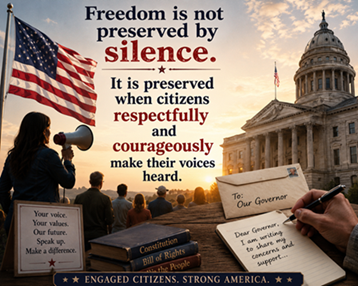
With everything happening in the United States—immigration issues, government corruption, attacks on our Second Amendment rights, and a struggling economy—it’s more important than ever for We the People to take a stand. We can no longer sit back and believe that there’s nothing we can do. It’s time for us to actively voice our concerns and make our desires known to those in power. Our involvement and engagement are crucial for shaping the future of our country.
Find and contact elected officials
Get the names and contact information for the people who represent you on the federal, state, and local levels.
I just wrote this comment to President Donald Trump:
I just read the latest news about the release of two children and several deceased hostages on Tuesday, followed by six hostages on Thursday and four more slain bodies expected to be released the following week.
Why are you Trump, allowing Hamas to dictate the terms? This must stop immediately.
We still don’t even know how many American citizens are still being held hostage.
Mr. President, I believe you have the power to bring all the hostages home. Please take decisive action to make this happen.
If you’re as fed up with this as I am, take action to show Trump how frustrated you are with the handling of the hostage releases. We all want our people brought home—alive, not dead, now, not later.
The Second Amendment of the United States Constitution stands as a cornerstone of our nation’s founding principles, guaranteeing the right of the people to keep and bear arms. This right is not merely a historical relic but a safeguard of individual freedom and a cornerstone of our national identity. However, in recent years, this constitutional protection has come under increasing scrutiny and threat, with legislative proposals aimed at imposing restrictions that many believe infringe upon this fundamental liberty. It is imperative for all of us who cherish our freedoms to take a stand and ensure that our voices are heard.
I urge every 2A supporter to contact their House or Senate representative and demand unwavering protection of our Second Amendment rights. Now is the time to remind our elected officials that the phrase “shall not be infringed” is not open to interpretation or compromise. By speaking out collectively, we send a clear message to our government: we will not tolerate any encroachment on the freedoms guaranteed to us by the Constitution. Together, we can preserve and protect this essential right for generations to come.
Below is a copy of both Bills so you can compare them.
When you look at both of them they’re pretty much the same except for the House bill.
In the House bill sec 6, 1, B
If I could advocate for a change, it would be to allow the freedom to manufacture personal suppressors without the requirement for serialization, whether they are homemade or purchased.
Throughout much of U.S. history, there have been few restrictions on the personal manufacture of firearms for personal use. Historically, individuals were generally free to make firearms for themselves without legal barriers.
HERE ARE SOME OF THEM
During the time of the writing of the U.S. Constitution (1787) and the ratification of the Bill of Rights (1791), there were very few restrictions on firearm ownership or manufacture. The Second Amendment, ratified in 1791, explicitly stated, “A well regulated Militia, being necessary to the security of a free State, the right of the people to keep and bear Arms, shall not be infringed.” This reflected a cultural and practical necessity for firearm ownership during the era.
However, there were a few notable restrictions or practices related to arms regulation during this time:
1. Militia Service Requirements
Many states had laws requiring able-bodied men to own firearms for militia service. These laws mandated that individuals possess arms and ammunition in working condition, effectively making firearm ownership not just a right but an obligation for many.
For example, the Militia Act of 1792 required all free, able-bodied white male citizens aged 18 to 45 to equip themselves with a musket, ammunition, and other supplies for militia duty.
2. Class and Racial Restrictions
Some laws restricted firearm ownership for enslaved people and free Black individuals. For example:
Virginia (1640s onward): Laws prohibited enslaved people from owning firearms, and even free Black individuals often required special permissions.
Other colonies and states had similar restrictions aimed at maintaining control over marginalized populations.
3. Firearm Use in Public Spaces
Certain municipalities or colonies enacted laws to regulate the carrying or discharge of firearms in specific settings, such as within town limits or during public gatherings. These restrictions were often aimed at preventing accidents or maintaining public order, not disarming the populace.
For instance, some towns prohibited the firing of guns during celebrations or near public buildings.
4. Storage and Maintenance Requirements
In some places, laws required firearms to be properly maintained and stored to ensure they were available for militia use. This was less about restricting ownership and more about ensuring readiness.
5. Restrictions on Gunpowder
Many towns and cities had regulations on the storage and transportation of gunpowder due to the risk of fire and explosions. For example:
Boston (1720s): Laws limited how much gunpowder could be stored in homes and required it to be kept in designated storage facilities.
Notable Absence of Restrictions:
There were no federal or state laws restricting the manufacture of firearms for personal use, and individuals were free to make or modify their own weapons.
Serialization, background checks, licensing, and other modern regulatory mechanisms did not exist.
Summary
At the time of the Constitution’s writing, most restrictions related to firearms were tied to militia service, public safety, and social control (e.g., racial exclusions). There were no federal restrictions on personal firearm manufacture, and the prevailing attitude strongly supported widespread ownership and use of arms, both for individual self-defense and collective security.
I just emailed my congressman to express my support for this bill. I also suggested a change to remove Section 6, 1, B, as it restricts the ability to manufacture personal suppressors and requires serialization for purchased suppressors, which I believe should not be mandatory.
I encourage all 2A supporters to reach out to their House and Senate representatives and urge them to stand against any attempts to impose restrictions on our Second Amendment rights, which clearly state, “the right of the people to keep and bear Arms, shall not be infringed.” Let’s make our voices heard and protect our freedoms.