

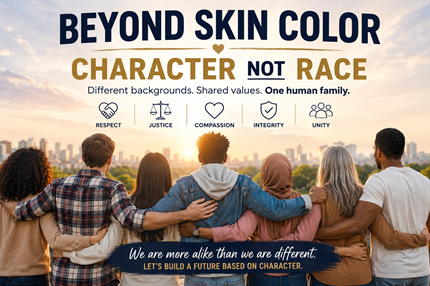
“The content of our character is far more important than the color of our skin.”
Few topics generate more emotion today than race. Conversations often become polarized before they even begin. Some believe racism is the defining issue of our society, while others believe it is discussed so often that it overshadows the progress that has been made.
Regardless of where we stand politically or culturally, most people can agree on one important truth: every person deserves to be treated with dignity and respect.
Beyond Skin Color: Character, Not Race (English) PDF: DOWNLOAD
Understanding Racism
Racism is commonly defined as prejudice, discrimination, or unequal treatment directed toward individuals because of their race or ethnicity. Throughout history, racism has caused tremendous suffering, injustice, and division.
Scholars often describe racism as operating on four levels:
- Internalized racism – accepting stereotypes about one’s own race or another race.
- Interpersonal racism – discrimination or prejudice between individuals.
- Institutional racism – policies or practices within organizations that result in unequal treatment.
- Structural racism – broader historical and societal patterns that contribute to unequal outcomes across institutions.
Recognizing these concepts helps us understand why conversations about race remain important. Yet understanding racism should not become an excuse to judge people solely by the racial group to which they belong.
The Danger of Replacing One Form of Judgment with Another
History teaches us that judging people by race is wrong.
It was wrong when people assumed someone was inferior because of their skin color.
It is equally wrong when we assume someone’s beliefs, motives, character, or moral worth simply because they belong to a particular racial or ethnic group.
Prejudice is still prejudice, even when it changes direction.
When we begin assigning guilt or innocence based solely on race, we move away from justice and toward another form of stereotyping.
Character Is What Defines a Person
Character cannot be inherited.
It cannot be determined by ancestry.
It is revealed by our choices.
Honesty.
Integrity.
Compassion.
Humility.
Courage.
Personal responsibility.
These qualities exist in every nation, every ethnicity, every language, and every culture.
Likewise, selfishness, dishonesty, hatred, violence, greed, and prejudice can also be found in every race and culture.
No race has a monopoly on virtue.
No race has a monopoly on vice.
Every human being is capable of both good and evil.
Recognizing this reality allows us to see individuals instead of stereotypes.
What the Bible Says
The Bible consistently points us toward judging people by their heart rather than outward appearance.
“The LORD sees not as man sees: man looks on the outward appearance, but the LORD looks on the heart.”
— 1 Samuel 16:7 (ESV)
James warns believers against showing favoritism.
“My brothers, show no partiality as you hold the faith in our Lord Jesus Christ.”
— James 2:1 (ESV)
The Apostle Paul reminds Christians that our identity in Christ transcends ethnic divisions.
“There is neither Jew nor Greek… for you are all one in Christ Jesus.”
— Galatians 3:28 (ESV)
These passages do not erase our cultural backgrounds. Instead, they remind us that every person bears the image of God and deserves equal dignity.
Recognizing Progress While Continuing the Work
Our society has made remarkable progress over the past several decades.
Laws have changed.
Educational opportunities have expanded.
Many barriers that once existed have been removed.
Yet racism has not disappeared entirely.
There are still individuals who harbor prejudice.
There are still people who experience discrimination.
Acknowledging these realities does not mean we must define every interaction through the lens of race. We can recognize both progress and remaining challenges at the same time.
How We Can Shift the Conversation
If we want future generations to live in a less divided society, we must intentionally change how we relate to one another.
1. See Individuals First
Avoid assuming someone’s beliefs, values, or intentions because of race.
Every person has a unique story.
2. Build Real Relationships
Friendships across cultural backgrounds reduce stereotypes far more effectively than arguments on social media.
People are much harder to stereotype once we truly know them.
3. Practice Humility
We all have blind spots.
Listening respectfully does not require agreeing with every opinion.
It requires recognizing that we can always learn.
4. Reject All Forms of Prejudice
Whether prejudice is directed toward minorities, majorities, immigrants, or any other group, it should be rejected consistently.
Justice requires equal standards for everyone.
5. Teach Character Early
Parents, teachers, churches, and community leaders should emphasize virtues like honesty, kindness, responsibility, forgiveness, and respect.
Character education creates better citizens than teaching children to divide themselves into competing groups.
6. Celebrate Cultural Differences Without Creating Division
Cultures contribute beautiful traditions, food, music, language, and history.
We can appreciate diversity without allowing it to become a source of hostility.
What Anti-Racism Can Look Like
Organizations such as the United Nations encourage combating racism through education, listening to those who experience discrimination, challenging prejudice, and supporting fair policies.
Many of these principles can strengthen communities when they are applied consistently and fairly.
Self-examination helps us recognize our own biases.
Listening helps us understand experiences different from our own.
Speaking against prejudice helps prevent hatred from spreading.
Supporting equal opportunity promotes fairness for everyone.
These efforts are most effective when they are rooted in a commitment to equal human dignity rather than assumptions about entire groups.
The Future We Should Pursue
Imagine a society where introductions begin with names rather than labels.
Where children are taught to admire honesty more than appearance.
Where employers evaluate competence.
Where neighbors extend kindness before suspicion.
Where disagreement does not become hatred.
This vision is not color-blindness. It is recognizing that our shared humanity is greater than our differences.
Race is one aspect of who we are.
Character determines who we become.
Final Thoughts
The fight against racism is not won by creating new divisions.
It is won by refusing to judge people by categories and choosing instead to evaluate each person by their actions, integrity, and character.
Good people exist in every race.
Bad people exist in every race.
History demonstrates both realities.
Our challenge is to stop assuming the best or the worst based on appearance and instead recognize the unique worth of every individual.
As Martin Luther King Jr. expressed so memorably, the goal is that people “will not be judged by the color of their skin but by the content of their character.”
That vision remains as relevant today as it was when he first spoke those words.
Copyright Notice © 2025 Dr. Cecil W Thorn, Ph.D. (Theology). Permission is hereby granted, free of charge, to any person obtaining a copy of this work authored by Dr. Cecil W Thorn, Ph.D. (Theology) to distribute, display, and reproduce the work, in its entirety, including verbatim copies, provided that no fee is charged for the copies or distribution. This permission is granted for non-commercial distribution only.