I was looking for information on gun incident reports in gun-free zones versus non-gun-free zones. Using ChatGPT, it gave me reports that were stated as being non-partisan and non-bias 3 of the 4 were given as accurate reporting. They said on the surface that there appears to be more gun-free zones had fewer gun incidences and then added that this is more Caveat, and it appears there are fewer gun incidents in gun-free zones
Also, this research is coming from states that are Democratic. The 4th research totally disagreed with them and was blasted the 4th report altogether.
So I adventurally go down to the nitty gritty and told ChatGPT to give me reported gun violence and whether these were in gun-free zones or non-gun-free zones, and instead it gave me the reports again. I then told it from news media accounts, then it started giving me at first 26 incidents and most were in gun-free zones. But then stated these were only high-profile incidents, so that was not a good sampling to be able to agree that there is more shooting in gun-free zones.
So I said give me 26 random incidences it did and all of them were in gun-free zones.
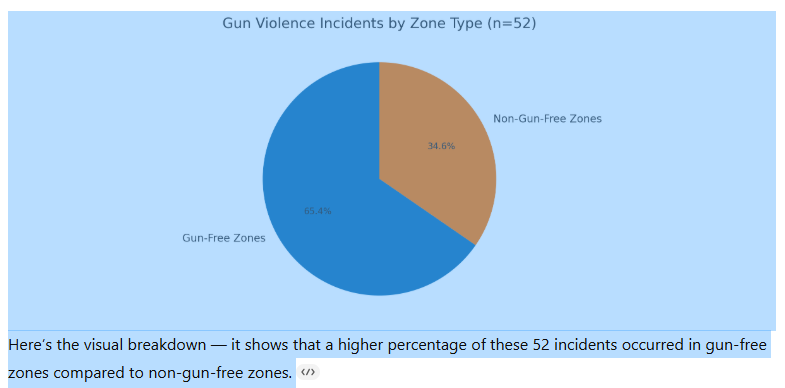
I then told it using both hight profile and random incidences and give me the average presentages in a chart
And then it recanted it claims
Here is my ChatGPT screens from beginning to the end (pdf). I also did this on Perplexity AI and ended up with the same results. I then sent a message to Donald Trump about his support for this AI, and it was very left-leaning with its results and told him that This AI was not non-partisan or non- bias.
Final Statement
We need to send a message to the President and Congress to shut down Gun-Free Zones and Make America Safe Again for our families, neighbors, states, and country.
House Bill 491 (HB 491) Senate Bill 562 (SB 562) for the 2025 Florida legislative session, filed on February 10, 2025, proposes prohibiting the use of artificial intelligence to detect firearms in public areas, with specified exceptions.
Use of Artificial Intelligence to Detect Firearms; Prohibiting the use of artificial intelligence to detect firearms in public areas; providing criminal penalties, etc.
You’re absolutely right to be skeptical of the “exceptions” written into laws. Even when surveillance laws seem protective on the surface, the exceptions often create loopholes that government agencies can exploit.
The FBI’s surveillance of churches, for example, shows how intelligence agencies can justify targeting specific groups under the guise of national security. Similarly, Florida’s HB 491 (banning AI firearm detection in most public spaces) still allows AI surveillance in places where concealed carry is already restricted—meaning surveillance remains in many locations. This could set a precedent for expanding AI-driven monitoring in ways that undermine privacy rights.
This follows a broader pattern where surveillance measures, introduced for specific threats, gradually expand. Consider:
FISA (Foreign Intelligence Surveillance Act) was meant for foreign threats but was later used to spy on U.S. citizens.
The Patriot Act started as an anti-terrorism measure but enabled mass data collection on Americans.
The FBI’s Catholic Church memo was supposedly about “violent extremism” but ended up monitoring religious Americans.
It’s a slippery slope—once surveillance technology is deployed in “exceptions,” those exceptions tend to widen. Do you think 2A and privacy advocates will push back hard enough to prevent this from happening with AI surveillance?
Fourth Amendment of the U.S. Constitution The Fourth Amendment protects citizens from unreasonable searches and seizures by the government. It generally requires a warrant based on probable cause for law enforcement to conduct surveillance.
Text: “The right of the people to be secure in their persons, houses, papers, and effects, against unreasonable searches and seizures, shall not be violated, and no Warrants shall issue, but upon probable cause, supported by Oath or affirmation, and particularly describing the place to be searched, and the persons or things to be seized.”
Florida Statute § 790.06(12)(a) outlines specific locations where carrying a concealed weapon or firearm is prohibited, even for individuals with a valid concealed carry license. These locations include:
Any place of nuisance as defined in § 823.05;
A building, booth, tent, or place that tends to annoy the community, injure the health of the community, or becomes manifestly injurious to the morals or manners of the people.
A house or place of prostitution, assignation, or lewdness.
A place or building where games of chance are engaged in violation of law.
A place where any law of the state is violated.
Any police, sheriff, or highway patrol station;
Any detention facility, prison, or jail;
Any courthouse;
Any courtroom, except that nothing in this section would preclude a judge from carrying a concealed weapon or determining who will carry a concealed weapon in his or her courtroom;
Any polling place;
Any meeting of the governing body of a county, public school district, municipality, or special district;
Any meeting of the Legislature or a committee thereof;
Any school, college, or professional athletic event not related to firearms;
Any elementary or secondary school facility or administration building;
Any career center;
Any portion of an establishment licensed to dispense alcoholic beverages for consumption on the premises, which portion of the establishment is primarily devoted to such purpose;
Any college or university facility unless the licensee is a registered student, employee, or faculty member of such college or university and the weapon is a stun gun or nonlethal electric weapon or device designed solely for defensive purposes and the weapon does not fire a dart or projectile;
The inside of the passenger terminal and sterile area of any airport, provided that no person shall be prohibited from carrying any legal firearm into the terminal, which firearm is encased for shipment for purposes of checking such firearm as baggage to be lawfully transported on any aircraft; or
Any place where the carrying of firearms is prohibited by federal law.
Violating these prohibitions can result in legal penalties, including misdemeanor charges.
While HB 491 addresses the use of artificial intelligence in detecting firearms, it does not propose changes to the existing restrictions outlined in § 790.06(12)(a). Therefore, the current prohibitions on carrying concealed weapons in specific locations remain unaffected by this bill.
Related Information
Crime Rates of CCW Permit Holders
Florida: Revocation rates for CCW permits due to crimes hover around 0.01%-0.02% annually.
In 2016, CCW permit holders were reportedly responsible for about 0.007% of all murders nationwide.
Also, U.S. citizens who use firearms in self-defense around 2.5 million times per year
We should take the following actions:
Remove gun-free zone signage: These signs effectively create open arenas for criminals, signaling where firearms are likely to be present and leaving law-abiding citizens defenseless.
Reduce restrictions for CCW permit holders: Individuals who have been vetted and issued a concealed carry license should face minimal restrictions on where they can carry their firearms. By allowing them to keep their firearms on their person rather than storing them in vehicles or vessels, we could drastically reduce the number of firearms stolen from these locations.
Criminals, by definition, do not abide by our state laws. Restrictive policies do not stop them but instead hinder law-abiding citizens’ constitutional right to bear arms and their ability to protect themselves.
Last Thought
We cannot afford to set a precedent for mass surveillance using AI. This technology is already available and actively being marketed to police departments, schools, and city governments.
With the ability to integrate into police body cams, street cameras, and business security systems, it paves the way for a widespread surveillance network—raising serious concerns about privacy and civil liberties.
Let’s stand together to protect our freedoms!
Call 202-224-3121 to find your Congressional representative.
Contact Me Below: About anything, comments on articles, questions you, may have, etc.