

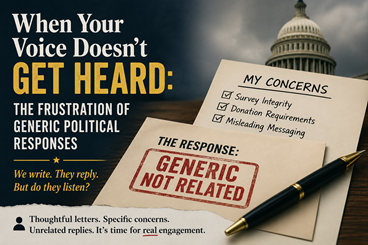
The Effort We Put In
There’s a belief many Americans still hold:
If you take the time to write—clearly, respectfully, and with specific concerns—someone on the other end will read it and respond thoughtfully.
I recently put that belief to the test.
Click here to read my original Blog
Download my letter —Download their response
In my letter, I raised a very specific issue:
- Political “surveys” being tied to required or pressured donations
- Messaging that creates false urgencyMy
- A concern about whether feedback is truly being collected or simply monetized
I wasn’t vague. I wasn’t emotional. I was direct and constructive.
“A survey should collect opinions freely… restricting participation behind a contribution creates the impression that only paid responses are valued.”
I even listed clear, reasonable requests:
- Remove donation requirements for surveys
- Fix misleading language
- Increase transparency
This is what civic engagement is supposed to look like.
The Response I Received
Then came the reply.
Dated April 23, 2026, the response thanked me—but for something I never wrote about:
“Thank you for taking the time to express your views regarding immigration policy.”
That’s where the disconnect becomes impossible to ignore.
My letter was about fundraising practices and survey integrity.
The response was entirely about:
- Immigration policy
- Border security
- Legislative accomplishments
Not a single sentence addressed:
- Surveys
- Donations
- Messaging practices
- Or any of the three requests I made
What This Reveals
This isn’t just a one-off mistake. It reveals a pattern that many people quietly experience:
1. Template Responses Are Driving the System
The reply reads like a pre-written script. It likely wasn’t written in response to my letter at all—but selected from a set of standard responses.
2. Keywords Replace Actual Reading
Somewhere along the line, something triggered “immigration” as a category—even though my letter had nothing to do with it. That suggests filtering, tagging, or automation—not human engagement.
3. Engagement Is One-Way
We are encouraged to:
- Write letters
- Fill out forms
- Share feedback
But the system appears optimized for:
- Sending messaging out
- Not receiving or processing input in
Why It Feels Like It Doesn’t Matter
When this happens repeatedly, it creates a deeper issue:
You begin to question the value of participation.
If:
- Your concerns are not read
- Your points are not addressed
- Your effort is met with unrelated messaging
Then what is the purpose of reaching out?
It gives the impression that:
- Responses are performative, not responsive
- Communication is transactional, not relational
- Feedback is collected, but not considered
The Real Cost: Loss of Trust
The issue here isn’t political—it’s structural.
When people stop believing their voice matters:
- They disengage
- They stop writing
- They stop participating
And that’s where the real damage happens—not in disagreement, but in silence.
What Should Be Happening Instead
At a minimum, any response should:
- Acknowledge the actual topic raised
- Address at least one of the specific concerns
- Clarify if the issue is being reviewed or redirected
Even a simple, honest response like:
“Your concern about survey practices has been forwarded to the appropriate team”
…would have shown that the letter was actually read.
Final Thought
This This experience raises a fundamental question:
Are we truly being heard—or simply processed?
When thoughtful, specific communication receives a response that is entirely unrelated, it does more than miss the point—it underscores a deeper systemic issue.
Interactions of this kind appear increasingly routine, not confined to any single political group but evident across the broader landscape. It leads many to ask: When will constituents genuinely be heard? There is a growing perception that some state and federal representatives prioritize their own agendas, offering messages that resonate during engagement, yet failing to follow through once in office.
That said, it is important to acknowledge that there are representatives who demonstrate genuine concern for their constituents—listening carefully and taking meaningful action. However, such examples often seem to be the exception rather than the rule.experience forces a hard question:
From My Heart to Yours
Taking the time to speak up still matters—more than it may feel in moments like this. While experiences like these can reveal gaps in how the system listens, they do not diminish the value of your voice or the importance of using it.
Every letter sent, every concern raised, is a reminder that engagement is still alive. Change rarely happens all at once—it builds over time through persistence, clarity, and the willingness to continue speaking when it feels difficult.
So don’t mistake a poor response for a wasted effort.
Even when it seems like your words didn’t land where you intended, they still carry weight. And as more voices continue to rise with purpose and conviction, the call for genuine listening becomes harder to ignore.
Your voice matters. Keep using it.
Copyright Notice © 2025 Dr. Cecil Wayne Thorn . Permission is hereby granted, free of charge, to any person obtaining a copy of this work authored by Cecil Wayne Thorn, to distribute, display, and reproduce the work, in its entirety, including verbatim copies, provided that no fee is charged for the copies or distribution. This permission is granted for non-commercial distribution only