

From Concern to Conversation
On April 16, 2026, I sent a formal letter addressing a growing concern regarding political text message campaigns—specifically those tied to surveys that appear to require a donation before responses can be submitted.
What prompted this outreach was not simply the frequency of the messages, but the structure behind them.
A survey, by definition, is meant to gather honest feedback. When access to participation is restricted—either directly or indirectly—by requiring a financial contribution, the purpose of that survey is fundamentally compromised.
The Issue: When Feedback Becomes Conditional
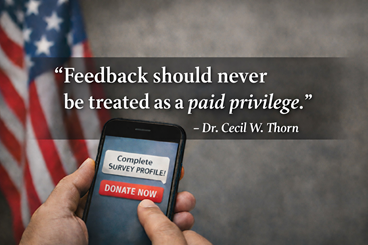
In recent communications, I received repeated text messages encouraging completion of a “PROFILE” survey. However, upon attempting to participate, it became clear that responses could not be submitted without making a donation.
This raises a serious concern:
- Is the survey truly collecting opinions?
- Or is it primarily functioning as a fundraising mechanism?
When participation is gated behind payment, it creates the impression that only those who contribute financially are allowed to have their voices heard. That is not representative engagement—it is selective feedback.
The Problem with Pressure-Based Messaging
One message stood out in particular:
“We’re GIVING UP, Cecil. We’ve texted you 7X asking you to complete your PROFILE. Did we lose you? Last chance:”
This type of language introduces unnecessary urgency and pressure. It suggests disengagement on the recipient’s part, when the real barrier is structural—responses cannot be submitted without a donation.
This approach does two things:
- Misrepresents the situation
- Undermines trust between organizations and the public
Why This Matters
Surveys are often used to:
- Gauge public opinion
- Shape messaging
- Inform policy priorities
If responses are limited to those willing or able to donate, the data becomes skewed. It no longer reflects a broad base—it reflects a filtered audience.
That has real consequences:
- Inaccurate representation of supporters
- Reduced credibility of collected data
- Erosion of public trust
A Reasonable Path Forward
In my letter, I made three clear and reasonable requests:
1. Open Access to Surveys
Survey participation should be available without requiring a financial contribution.
2. Honest and Clear Messaging
Communication should reflect reality—no implied urgency or misleading framing.
3. Transparency in Data Collection
Organizations should clearly state whether survey responses are independent from fundraising efforts.
These are not partisan concerns—they are principles of fairness and integrity.
Restoring Trust Through Transparency
Feedback should never be treated as a paid privilege.
If organizations genuinely seek to understand the people they represent, they must ensure that every voice has equal opportunity to be heard—regardless of financial contribution.
Trust is not built through pressure.
It is built through honesty, accessibility, and respect.
Final Thought
This issue goes beyond a single message or campaign. It speaks to a broader question:
Do we value input—or do we value transactions?
If the goal is meaningful engagement, then the path forward is clear:
Remove barriers, speak plainly, and let people be heard.
Copyright Notice © 2025 Dr. Cecil Wayne Thorn . Permission is hereby granted, free of charge, to any person obtaining a copy of this work authored by Cecil Wayne Thorn, to distribute, display, and reproduce the work, in its entirety, including verbatim copies, provided that no fee is charged for the copies or distribution. This permission is granted for non-commercial distribution only