The Secret to Getting Your Voice Heard in Government

“Practical strategies for ensuring your concerns reach policymakers.”

Great — here are some practical tips to increase the chances that your message makes it past the sorting stage and into the policymakers’ daily briefing or staff reports:

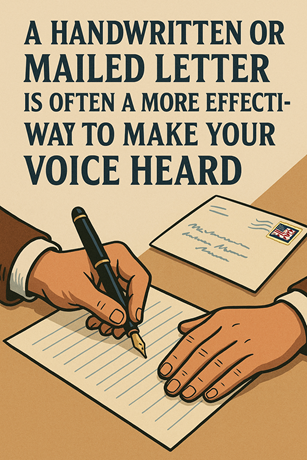
“A handwritten or mailed letter is often a more effective way to make your voice heard. The White House receives 40,000–50,000 emails every day, most of which are reduced to summaries and trend reports. By contrast, a handful of letters—perhaps 10—are chosen for the policymakers’ daily briefing folder.”


1. Be Personal, Not Generic

  • Share a personal story or experience that connects to a larger issue.
  • Instead of just saying “I oppose higher taxes,” explain how a specific policy impacts you, your family, or your community.
  • Staff look for letters that put a human face on a policy.

2. Keep It Clear and Focused

  • Stick to one main issue per message.
  • Use simple, direct language instead of long explanations.
  • Avoid clutter — a focused story or argument is easier for staff to pull and summarize.

3. Connect to National Values

  • Relating your concern to American ideals (freedom, fairness, opportunity, the Constitution, the Bible if appropriate for you) makes it resonate more.
  • Example: “I believe protecting the Second Amendment is part of protecting the freedoms our nation was founded upon.”

4. Show Respect and Sincerity

  • Avoid insults, sarcasm, or angry rants — those are less likely to be passed up the chain.
  • A firm but respectful tone has a greater chance of being taken seriously.

5. Be Timely

  • Reference a current event, bill, or policy debate.
  • Timely messages are more likely to be chosen because they connect with what the President and staff are already discussing that day.

6. Make It Shareable

  • Write in a way that makes your message quotable.
  • Short, memorable sentences often stand out.
  • Example: “When government spending grows, my family’s grocery budget shrinks.”

7. Send It Through the Right Channel

  • Use the official White House contact form (https://www.whitehouse.gov/contact/) — this is the fastest way to get into the system.
  • For especially important issues, send both an online message and a physical letter (mailed letters often carry extra weight because fewer people take the time to write them).

Pro Tip: If you’re writing on behalf of an organization or church, note how many people you represent. Saying “I’m writing on behalf of 200 families in our congregation” gives the letter more influence than just speaking as one individual.


Let me know what you think below


Copyright Notice © 2025 Cecil Wayne Thorn Permission is hereby granted, free of charge, to any person obtaining a copy of this work authored by Cecil Wayne Thorn, to distribute, display, and reproduce the work, in its entirety, including verbatim copies, provided that no fee is charged for the copies or distribution. This permission is granted for non-commercial distribution only.


Right to Bear Arms

Wayne Thorn

The development of the Constitution, particularly the Second Amendment, was rooted in the desire to safeguard individual liberties by affirming the people’s right to own and carry firearms free from government interference. The amendment’s language—“the right of the people to keep and bear Arms, shall not be infringed”—was crafted to protect this fundamental freedom, ensuring the ability to defend oneself and resist oppression. Given this intent, it raises an important question: Why do modern gun laws exist that impose restrictions on this constitutional right?

The Bruen case (New York State Rifle & Pistol Association v. Bruen, 2022) reinforced a historical approach to interpreting the Second Amendment, establishing that any laws or regulations infringing on the right to bear arms must align with the standards set in 1791, when the amendment was ratified. This decision emphasized that laws must be consistent with historical practices and traditions surrounding firearms during that period. When we look at the standards of 1791, we find that the founding era was characterized by minimal government regulation on firearm ownership. The prevailing norms were that citizens had the right to possess and carry arms for purposes of self-defense, militia service, and hunting, with few formal restrictions. The government did not impose licensing or registration requirements, and there were few, if any, bans on types of firearms. In fact, most able-bodied men were expected to own arms for the purpose of participating in local militias. These historical standards, therefore, suggest that many modern gun laws—particularly those involving bans on certain weapons or restrictions on where firearms can be carried—may not align with the original intent of the Second Amendment.


What were the firearm laws in 1791?

In 1791, when the Second Amendment to the United States Constitution was ratified, firearm laws and regulations were minimal compared to modern standards. Here’s a summary of the context and practices of the time:

Key Points About Firearm Laws in 1791

  1. Second Amendment:
    • Ratified in 1791, it states:
      “A well regulated Militia, being necessary to the security of a free State, the right of the people to keep and bear Arms, shall not be infringed.”
    • This reflected the belief that citizens should be armed to ensure collective defense and safeguard against tyranny.
  2. State-Level Regulations:
    • Firearm regulations varied by state but were generally sparse. States prioritized arming militias and ensuring citizens could defend themselves.
    • Some states required able-bodied men to own firearms for militia duty and even mandated inspections of weapons to ensure they were functional.
  3. Federal Laws:
    • The federal government had almost no firearm laws in 1791. Regulation of arms was left largely to states and localities.
  4. Types of Firearms:
    • Firearms were limited to single-shot, muzzle-loading muskets, rifles, and pistols. These weapons were slow to load and less lethal than modern firearms.
  5. Cultural and Practical Norms:
    • Firearms were primarily used for hunting, self-defense, and militia service.
    • Ownership was widespread among men, particularly in rural areas, where firearms were tools for survival.
  6. Restrictions:
    • Although there were no federal restrictions, some communities placed informal or local restrictions on firearm use, such as laws against discharging firearms within town limits or prohibiting possession by certain groups (e.g., enslaved people and, in some cases, free Black individuals).
  7. Militia Acts:
    • The Federal Militia Act of 1792 required most free, white male citizens aged 18-45 to enroll in the militia and provide their own arms and ammunition. This effectively mandated firearm ownership for many.

Notable Omissions:

  • No registration or licensing systems.
  • No restrictions on the type of firearms owned.
  • No background checks or waiting periods.

Conclusion:

Firearm laws in 1791 reflected the era’s priorities—ensuring public defense and individual preparedness for survival. Regulations were minimal and focused on maintaining armed militias rather than restricting individual ownership.


My Thoughts

If we interpret the Second Amendment as it was originally intended, without compromise or modification, then all current firearm laws—whether federal, state, or local—would be unconstitutional. The phrase “shall not be infringed” in the amendment clearly indicates that the right to keep and bear arms cannot be restricted or limited by the government in any way. This understanding challenges modern gun control laws that impose restrictions like background checks, licensing, or weapon bans. Such laws, from this viewpoint, violate the very essence of the Second Amendment and should therefore be struck down to restore the full rights of citizens to bear arms without any governmental interference.

The Second Amendment recognizes the right to own and carry firearms as an inherent right, not a privilege that can be granted or revoked by the government. This distinction is critical—rights are fundamental and unalienable, whereas privileges can be regulated or taken away. By framing the right to bear arms as a constitutional right, the founders intended to empower individuals to protect themselves and ensure a balance of power between the people and the government. As such, any law that infringes upon this right, no matter the justification, runs counter to the Constitution’s clear intent and should be invalidated, ensuring that the full freedom to keep and bear arms is restored to every American citizen.

Try That In A Small Town

SMALL TOWN

Need to listen to this!

This song is not about trying to start riots, this just tell the story about what has gone on in the US now.

Then stating this would not happen in the small town in the US, because they look out for each other and help each other.

FREE speech is a constitutional right for all people to be able to vocalize there concerns to each other and the government , but does not give you the right to riot, destroying property, stealing or hurting individuals.


NOTE: Comments will not appear until approved by the moderator


How many self-defense shooting where there in 2022?

The CDC compiled there annual report on deaths in December 2022.

There was one line about self-defense shooting that was removed under pressure by the US goverment to remove that line from the report.

That because it showed that around 2.2 million self-defense shootings had happened in 2022.

This is what the goverment didn’t want you to see, that more life’s where saved by individual licensed gun carrier’s, then by all the criminals use of firearms.

Why The Mainstream Media Drastically Underreports Defensive Gun Use.