“Practical strategies for ensuring your concerns reach policymakers.”
Great — here are some practical tips to increase the chances that your message makes it past the sorting stage and into the policymakers’ daily briefing or staff reports:
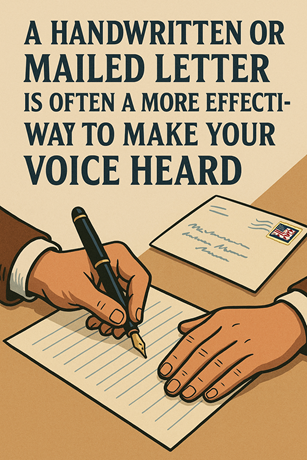
“A handwritten or mailed letter is often a more effective way to make your voice heard. The White House receives 40,000–50,000 emails every day, most of which are reduced to summaries and trend reports. By contrast, a handful of letters—perhaps 10—are chosen for the policymakers’ daily briefing folder.”
1. Be Personal, Not Generic
- Share a personal story or experience that connects to a larger issue.
- Instead of just saying “I oppose higher taxes,” explain how a specific policy impacts you, your family, or your community.
- Staff look for letters that put a human face on a policy.
2. Keep It Clear and Focused
- Stick to one main issue per message.
- Use simple, direct language instead of long explanations.
- Avoid clutter — a focused story or argument is easier for staff to pull and summarize.
3. Connect to National Values
- Relating your concern to American ideals (freedom, fairness, opportunity, the Constitution, the Bible if appropriate for you) makes it resonate more.
- Example: “I believe protecting the Second Amendment is part of protecting the freedoms our nation was founded upon.”
4. Show Respect and Sincerity
- Avoid insults, sarcasm, or angry rants — those are less likely to be passed up the chain.
- A firm but respectful tone has a greater chance of being taken seriously.
5. Be Timely
- Reference a current event, bill, or policy debate.
- Timely messages are more likely to be chosen because they connect with what the President and staff are already discussing that day.
6. Make It Shareable
- Write in a way that makes your message quotable.
- Short, memorable sentences often stand out.
- Example: “When government spending grows, my family’s grocery budget shrinks.”
7. Send It Through the Right Channel
- Use the official White House contact form (https://www.whitehouse.gov/contact/) — this is the fastest way to get into the system.
- For especially important issues, send both an online message and a physical letter (mailed letters often carry extra weight because fewer people take the time to write them).
✨ Pro Tip: If you’re writing on behalf of an organization or church, note how many people you represent. Saying “I’m writing on behalf of 200 families in our congregation” gives the letter more influence than just speaking as one individual.
Let me know what you think below
Copyright Notice © 2025 Cecil Wayne Thorn Permission is hereby granted, free of charge, to any person obtaining a copy of this work authored by Cecil Wayne Thorn, to distribute, display, and reproduce the work, in its entirety, including verbatim copies, provided that no fee is charged for the copies or distribution. This permission is granted for non-commercial distribution only.