Harris – will go back to her Marxist ways

Cecil Thorn

The former president Trump interpreted Sanders’ comments on Fox News as an admission that Harris had only changed her “Marxist policy positions” for the election and would revert to her original stances once in office.

Why does Kamala Harris frequently shift her policy positions and fail to present comprehensive policy outlines for the public to review, instead offering only fragments at rallies?

Why does she adjust her accent based on the location of her rallies?


  1. Kamala Harris appears to be appealing to different groups by telling them what they want to hear, aiming to secure more votes. Instead of presenting a clear, comprehensive policy agenda for the public to review, she often provides selective or incomplete details, leaving voters without a full understanding of her plans.
  2. Kamala Harris adjusts her accent based on the location of her rallies to connect with different audiences. However, this tactic can sometimes be criticized as inauthentic, with some voters feeling that it’s an attempt to pander to specific groups rather than a display of genuine communication.

My Final Thought

Kamala Harris’ approach to communicating her policies, including selectively sharing details and adjusting her message to appeal to different groups, raises concerns about the clarity and transparency of her platform. By not providing comprehensive, accessible policy plans for the public to fully evaluate, voters are left without a complete understanding of where she stands on key issues. Her tendency to shift positions and tailor her rhetoric based on her audience can create uncertainty about what her actual priorities would be if she were elected President.

This lack of consistency and clarity may leave voters questioning what they will ultimately get with Harris in office. Without a firm, detailed agenda that is accessible to all, it’s difficult to know which policies she would prioritize or how her leadership would unfold. This uncertainty creates a challenge for those who are seeking strong, unwavering leadership and clear policy direction from a potential President.

Presidential Candidates: Key priorities and plans they intends to pursue.

2024 Trump Harris

Understanding how the policies and plans of each candidate could affect us is crucial because these decisions have real-world consequences that shape our daily lives and future. A candidate’s policies can impact the economy, healthcare, education, and social justice, directly influencing our financial stability, access to services, and quality of life. By analyzing their plans, we can make informed decisions that align with our values and needs, ensuring that the leadership we choose works in our best interests and those of our communities. This awareness empowers us to participate more actively in the democratic process and advocate for policies that promote a better future for everyone.


Donald Trump

If Donald Trump is reelected in 2024, he has outlined several key priorities and plans that he intends to pursue. These plans reflect his ongoing political themes and goals from his previous presidency, as well as new initiatives. Here are some of the major points:

2024 Republican Party Platform HERE

  • Tax Cuts: Trump has promised to further cut taxes, particularly for middle-income families, and potentially make the 2017 tax cuts permanent.
  • Deregulation: He plans to continue rolling back regulations on businesses, particularly in energy, finance, and healthcare, to stimulate economic growth.
  • Trade Policies: Trump is likely to return to his “America First” trade policies, which could include renegotiating trade deals and imposing tariffs to protect American industries.

2. Immigration:

  • Border Security: Trump plans to resume and expand the construction of the border wall along the U.S.-Mexico border. He also intends to implement stricter immigration policies, including reintroducing policies like “Remain in Mexico” and possibly reinstating travel bans on certain countries.
  • Immigration Reform: His plans include further limiting legal immigration and continuing efforts to end birthright citizenship.

3. Foreign Policy:

  • America First Approach: Trump is expected to continue his “America First” foreign policy, focusing on reducing U.S. involvement in foreign conflicts and prioritizing national interests.
  • China and Russia: He has emphasized a tough stance on China, focusing on trade, technology, and security issues. His approach to Russia could involve reducing tensions and seeking cooperation on certain global issues, though this has been controversial.
  • Middle East: Trump may continue to pursue peace agreements between Israel and Arab nations, similar to the Abraham Accords.

4. Energy Policies:

  • Energy Independence: Trump aims to increase domestic energy production, particularly in fossil fuels, to achieve U.S. energy independence. He has criticized Biden’s green energy policies and plans to reverse many of them.
  • Climate Policy: Trump is likely to withdraw from or weaken international climate agreements and reduce environmental regulations that he believes harm the U.S. economy.

5. Healthcare:

  • Repealing Obamacare: Trump has consistently advocated for repealing the Affordable Care Act (Obamacare) and replacing it with a system that promotes competition and reduces costs, though specific details have been less clear.
  • Drug Prices: He has also emphasized lowering prescription drug prices, continuing efforts from his first term.

6. Law and Order:

  • Crime and Policing: Trump has pledged to be tough on crime, advocating for strong law enforcement and opposing efforts to defund the police. He may push for stricter penalties on violent crime and drug trafficking.
  • Judicial Appointments: Continuing to appoint conservative judges to federal courts, including the Supreme Court, will likely be a priority.

7. Education:

  • School Choice: Trump is a strong advocate for school choice, including expanding charter schools and voucher programs that allow parents to choose where their children attend school.

8. Military and Veterans:

  • Defense Spending: Trump has advocated for maintaining or increasing defense spending to ensure military readiness and superiority.
  • Veteran Care: He plans to continue reforms to the Department of Veterans Affairs to improve healthcare and services for veterans.

9. Culture and Social Issues:

  • Cultural Conservatism: Trump is likely to continue emphasizing traditional values, opposing what he describes as “woke” culture, and pushing back against progressive social policies.
  • Free Speech: He may pursue policies to limit the influence of tech companies and protect free speech, particularly on social media platforms.

Trump’s future plans, if he is reelected, align with his previous presidency’s goals, emphasizing economic growth, national security, and conservative social values. His policies are expected to continue being divisive, appealing strongly to his base while facing significant opposition from his critics.


Kamala Harris

If Kamala Harris were to be elected as President, her plans would likely reflect a continuation and expansion of many of the Biden administration’s priorities, along with her own initiatives. Here’s an overview of what might be expected based on her political career, public statements, and current policy priorities:

1. Economic Policies:

  • Economic Equity: Harris has consistently emphasized addressing economic disparities. As president, she would likely prioritize policies aimed at reducing income inequality, supporting middle and lower-income families, and promoting economic opportunities for historically marginalized communities.
  • Support for Small Businesses: Harris might focus on providing more support for small businesses, especially those owned by women and minorities, through grants, loans, and tax incentives.
  • Workforce Development: She is likely to promote education and training programs to prepare workers for jobs in emerging industries, particularly in technology and clean energy.

2. Healthcare:

  • Universal Healthcare: While Harris supported “Medicare for All” during her 2020 presidential campaign, she has since indicated support for expanding the Affordable Care Act (Obamacare) as a more incremental approach. Her presidency would likely aim to increase healthcare coverage and reduce costs.
  • Women’s Health: Harris would likely be a strong advocate for protecting and expanding access to reproductive healthcare, including abortion rights, and addressing maternal health disparities, particularly among women of color.

3. Climate Change and Environmental Policy:

  • Aggressive Climate Action: Harris has a strong record on environmental issues and would likely push for ambitious climate policies, including significant investments in renewable energy, infrastructure, and jobs. She would likely support rejoining international climate agreements and taking a leading role in global climate efforts.
  • Environmental Justice: A key focus for Harris would be on environmental justice, ensuring that low-income communities and communities of color are protected from environmental hazards and benefit from the transition to a green economy.

4. Social Justice and Civil Rights:

  • Racial Justice: Harris would likely continue to focus on racial justice, including reforms in policing, criminal justice, and addressing systemic racism across various sectors. She has been a vocal advocate for police reform and might push for stronger federal oversight of police practices.
  • LGBTQ+ Rights: Harris is a strong supporter of LGBTQ+ rights and would likely advocate for policies to protect these rights, including federal legislation to protect against discrimination.

5. Immigration:

  • Comprehensive Immigration Reform: Harris would likely push for comprehensive immigration reform that includes a pathway to citizenship for undocumented immigrants, protections for Dreamers, and reforms to the asylum and refugee systems. She has advocated for more humane immigration policies and would likely seek to roll back Trump-era restrictions.
  • Border Security with Compassion: While she would likely support border security measures, Harris is expected to emphasize humane treatment of migrants and improvements to the immigration and asylum processes.

6. Education:

  • Access to Education: Harris is likely to advocate for increased access to education, including making community college free and reducing the burden of student loans. She has also supported increased funding for public schools, particularly in underserved areas.
  • Early Childhood Education: A strong proponent of early childhood education, Harris would likely push for universal pre-kindergarten and increased support for childcare.

7. Foreign Policy:

  • Diplomacy and Alliances: Harris would likely continue the Biden administration’s emphasis on strengthening international alliances and multilateralism. She would likely focus on diplomacy, human rights, and global cooperation to address issues like climate change and global health.
  • Humanitarian Focus: Harris might prioritize humanitarian efforts, including refugee resettlement and global health initiatives, as part of her broader foreign policy agenda.

8. Gun Control:

  • Stricter Gun Laws: Harris is a strong advocate for gun control and would likely push for stricter gun laws, including universal background checks, an assault weapons ban, and measures to prevent gun violence through red flag laws and other preventive strategies.

9. Women’s Rights:

  • Gender Equality: Harris would likely focus on policies aimed at closing the gender pay gap, expanding paid family leave, and supporting women in the workforce, particularly in leadership roles.
  • Combating Violence Against Women: Harris might advocate for stronger protections and resources for survivors of domestic violence, sexual assault, and human trafficking.

10. Technology and Innovation:

  • Tech Regulation: Harris might push for greater regulation of big tech companies, particularly around issues of privacy, data protection, and misinformation. She could also focus on expanding broadband access and digital literacy.

Kamala Harris’s presidency would likely reflect a blend of progressive ideals and pragmatic governance, with a focus on equity, justice, and inclusive economic growth. Her policies would likely build on her experience as a senator and vice president, with a strong emphasis on civil rights, climate action, and social justice.


My Thoughts

When choosing the leaders of our nation, it’s crucial to make informed decisions, as their policies will shape our future. The differences between the candidates are substantial. For instance, Trump has clearly outlined his plans for the country, which are readily accessible online. In contrast, Harris has not provided specific details about her agenda, though it’s likely her priorities will align with those mentioned above. However, there’s still uncertainty about how she would govern.

It’s essential to do your own research and reach your own conclusions. Consider which candidate’s vision aligns most closely with your beliefs about how the government should operate.

My opinion!

Cecil Thorn


Revelation 7:17 (ESV) says:

“For the Lamb in the midst of the throne will be their shepherd, and he will guide them to springs of living water, and God will wipe away every tear from their eyes.”

FTM-300DR and FT-857D configuration for Winlink Express

Here is how to configure your Yaesus FTM-300DR and FT-857D to work with Winlink Express, using Digirig Mobile modem , FTM-300 Cable or FT-857D Cable.

Note: The same Digirig Mobile Modem will work with both radios and the instructions below is the same for both radios.


Microphone Volume Level

On my Yeasu FTM-399DR is around 42

On my Yeasu FT-857D is around 45

Note: When trying to figure out the optimal volume level try the ones listed above as a starting point and you will then need to go UP or DOWN one click at a time until you find the best one for your radio.


If you have any questions or problems Contact ME below:


Subscribe to my website:

Loading

Ham Radio Reference Cards

ham radio emergency field operator

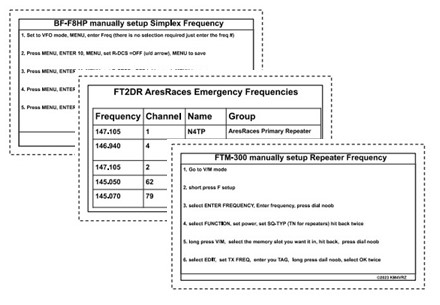
I have made up some business-size card that has reference information you could use in the field. Like how to manually program frequencies for simplex and repeater or Radio frequencies for your Ares/Races and others.

These are FREE Google slide files for anyone who wants them. Just do the simple steps below so you can modify them yourself.

  1. Click on the card you want below.
  2. Do FILE then Make A Copy select Entire presentation, and give it the name you want to call it, then select Make A Copy.

After you have done Make A Copy, you can modify it for your specific information.

NOTE: when you get ready to print your card, make sure that Scale% is set to Actual Size. Then Cut and Laminate.

  1. BF-F8HP for manual setup Simplex Frequency
  2. BF-F8HP for manual setup Repeater Frequency
  3. FTM 300dr for manual setup Repeater Frequency
  4. FTM 300dr for manual setup Simplex Frequency
  5. FTM-300dr Setting power level (TXPWR)
  6. Hillsborough FT2d Ares/Races Emergency Frequencies
  7. Hillsborough AresRaces PSO Email Addresses
  8. RTS System – Front
  9. RTS System – Back
  10. APRS Cheat Sheet
  11. Field jungle Antenna Card
  12. Local Frequencies
  13. FT2d Manually setup Simplex Frequency – Front
  14. FT2d Manually setup Repeater Frequency – Back
  15.  Hillsborough AresRaces Emergency Frequencies
  16. Polk AresRaces Emergency Frequencies
  17. Yeasu VX-6R: Program Repeater
  18. Yeasu VX-6R: Save to Memory
  19. Weather report to your radio using WXBOT (US only)
  20. Weather reports to your radio using WXYO (Worldwide)
  21. TTP APRS Message Group   and  PDF Document
  22. APRSTHURSDAY CHECK-IN FOR ANSRVR & EMAIL
  23. Baofeng UV-#R series for Manual Setup Simplex Frequency
  24. Baofeng UV-#R series for Manual Setup Repeater Frequency
  25. FT-857D Power settings and V/M,  Display lamp mode, Color, Dimmer 
  26. FT-857D Program Repeater, Save to Memory, Digital Settings, ATAS-120A, VHF/UHF & HF settings
  27. FT-857 Lakeland Frequencies and Memory #
  28. BTech UV-25X2 Lakeland Frequencies and Memory #
  29. FT-891 System Menu Operation, Memory Operation, Digital Operation, Digital Settings, Linux DigiRig Settings, Linux DigiRig Settings

I hope you enjoy them…..

KM4VRZ, 73


NOTE: all comments will not appear until approved by the moderator


Mass Shooting Stats 2023

mass shooting

Current 2023 Mass Shooting Stats by Tom Grieve


AR15s are INSANELY Safe: The Statistics about how Safe “Assault Weapons” Are

Guns DO NOT Murder People: Criminals Do! Statistics on Violence, Gun Ownership, and Gun Control


Here are statistics on pool death compared to AR15 mass shooting deaths that Tom Grieve was mentioning, that I found.

Pool Drowning Statistics

In the United States:

  • Annually, about 3,500 to 4,000 people die from drowning, averaging around 10 fatal drownings per day.
  • Drowning is the leading cause of unintentional injury-related death for children aged 1 to 4 years.
  • Between 2019 and 2021, there was an average of 358 pool- or spa-related fatal drownings for children under 15 years of age, with 75% of these victims being younger than 5 years old.
  • On average, from 2020 through 2022, there were an estimated 6,300 nonfatal pool- or spa-related drowning injuries treated in emergency departments each year for children under 15.

Mass Shooting Statistics

In the United States:

  • In 2023, there were 647 mass shootings, defined as incidents where four or more people are injured or killed, not including the shooter.
  • In 2022, there were 645 mass shootings.
  • The number of fatalities in mass shootings in 2022 was 636, with 2,912 people injured.
  • Children and teenagers (ages 0-17) were victims in about 5% of these incidents

Comparison

  • The annual number of drowning deaths (3,500 to 4,000) is higher than the total number of fatalities from mass shootings (636 in 2022).
  • Mass shootings, however, have a significant psychological and social impact, often drawing extensive media attention and prompting discussions on gun control and public safety.
  • Both issues highlight the need for preventive measures—water safety education and supervision to prevent drownings, and policy and community interventions to reduce mass shootings.

For further details on drowning prevention, you can visit Stop Drowning Now and the Consumer Product Safety Commission. For more information on mass shootings, resources like the Gun Violence Archive provide detailed statistics and analysis.


Email Subscription

Loading

NOTE: Comments will not show until approved by the Moderator.


USMC is looking at removing or changing their core values of Duty, Honor and Country

USMC logo

Removing “Duty, Honor, Country” from the ethos of the United States Marine Corps (USMC) is a decision that merits careful consideration and debate. However, it’s crucial to understand the rationale behind such a decision and evaluate its potential implications before forming a rebuttal.

  1. Contextual Understanding: Before rebutting, it’s important to understand the reasoning behind the removal of “Duty, Honor, Country.” Is it to modernize the ethos to better align with contemporary military operations and values? Is there evidence to suggest that these values are outdated or ineffective in the current geopolitical landscape? Understanding the context will inform the rebuttal.
  2. Core Values Preservation: “Duty, Honor, Country” are deeply ingrained in the traditions and history of the USMC. They encapsulate the core values that have guided Marines through generations. Removing them risks diluting the essence of what it means to be a Marine and could lead to a loss of identity and morale within the ranks.
  3. Moral Compass: Duty, Honor, Country serve as a moral compass for Marines, guiding their actions both on and off the battlefield. These values emphasize selflessness, integrity, and loyalty to the nation and its people. Removing them may create a void in ethical guidance, potentially leading to a decline in discipline and accountability among service members.
  4. Symbolic Importance: “Duty, Honor, Country” are not just words; they symbolize the sacrifices and commitments of Marines past and present. They inspire unity, resilience, and a sense of purpose among service members. Removing them could be perceived as a dismissal of these sacrifices and could erode the sense of pride and camaraderie within the Marine Corps community.
  5. Public Perception: The ethos of the USMC is not only significant internally but also shapes public perception and trust in the institution. “Duty, Honor, Country” resonate with civilians and reinforce confidence in the Marine Corps’ values and professionalism. Removing them may undermine public trust and lead to skepticism about the Marine Corps’ commitment to its foundational principles.

In conclusion, while changes to military ethos are not uncommon and can be necessary to adapt to evolving circumstances, the removal of “Duty, Honor, Country” from the USMC ethos should be approached with caution. Preserving these core values is essential for maintaining the integrity, identity, and effectiveness of the Marine Corps as a fighting force and a symbol of American strength and values.


Email Subscription

Loading

James Lindsay SHATTERS Woke Ideology

woke-divided-society-media-censorship

We all need to watch this – Lindsay provides comprehensive explanations regarding what is happening and how things are unfolding in the United States.

This is a little long but it will be worth it.


Email Subscription

Loading