
By: Wayne Thorn
“Education was never meant to be a battleground of ideologies, but a foundation fo:r virtue, wisdom, and responsible citizenship.”

Phoenix Declaration (PDF): Download
I recently came across a powerful document called The Phoenix Declaration: An American Vision for Education. After reading through its principles, I felt compelled to share why I believe this framework is not only timely—but absolutely essential for the future of our children and our nation. The Declaration is more than a policy statement; it is a call to return to the foundational purpose of education as understood by the architects of our Republic. It echoes the very ideals our Founding Fathers believed were necessary for a free people to remain free.
For generations, American education centered on truth, virtue, personal responsibility, and civic understanding. Our Founders knew that a nation built on liberty could not endure if its people drifted into ignorance or moral confusion. John Adams famously wrote that “public virtue cannot exist in a nation without private virtue,” reminding us that academic knowledge alone is not enough—our young people must also be formed in character. The Phoenix Declaration reawakens this insight by emphasizing academic excellence, moral clarity, and the transmission of our nation’s history and cultural heritage. These are not outdated ideas; they are the very foundations of a strong and united society.
In recent decades, however, our schools have shifted away from these core principles. Too often, classrooms have become platforms for ideological experimentation rather than centers of learning and wisdom. The rise of what many call “wokeness” has pushed education toward division, confusion, and political agendas that do little to prepare students for real life. The Phoenix Declaration stands in direct contrast to this trend. It calls for transparency between schools and parents, the rightful recognition of parents as the primary educators of their children, and a renewed commitment to objective truth. These standards promote unity, responsibility, and gratitude—qualities that strengthen both families and the broader culture.
For this reason, I strongly believe every state in our Republic should consider adopting the Phoenix Declaration as part of its educational guidelines for K–12 schools. It offers a clear, balanced, and principled path forward—one that reconnects our students with the wisdom of the past while preparing them for the future. By embracing this framework, we can help restore an education system that forms good citizens, cultivates moral character, and upholds the heritage that has made America a symbol of freedom and hope for the world. If we truly want to secure the blessings of liberty for the next generation, then returning to the educational vision of our Founding Fathers is not optional—it is essential.
“If you believe it’s time to get back to truth, virtue, and strong families, I encourage you to read the Phoenix Declaration and share it. Imagine every state building its K–12 education on these principles again. Our kids deserve better. Our country needs better. Let’s start the conversation.”
Let me know what you think below
Copyright Notice © 2025 Cecil Wayne Thorn Permission is hereby granted, free of charge, to any person obtaining a copy of this work authored by Cecil Wayne Thorn, to distribute, display, and reproduce the work, in its entirety, including verbatim copies, provided that no fee is charged for the copies or distribution. This permission is granted for non-commercial distribution only.
Posts
Posted onEdit”Why America Must Return to the Educational Vision of Our Founding Fathers”
Why America Must Return to the Educational Vision of Our Founding Fathers
By: Wayne Thorn
“Education was never meant to be a battleground of ideologies, but a foundation fo:r virtue, wisdom, and responsible citizenship.”
Phoenix Declaration (PDF): Download
I recently came across a powerful document called The Phoenix Declaration: An American Vision for Education. After reading through its principles, I felt compelled to share why I believe this framework is not only timely—but absolutely essential for the future of our children and our nation. The Declaration is more than a policy statement; it is a call to return to the foundational purpose of education as understood by the architects of our Republic. It echoes the very ideals our Founding Fathers believed were necessary for a free people to remain free.
For generations, American education centered on truth, virtue, personal responsibility, and civic understanding. Our Founders knew that a nation built on liberty could not endure if its people drifted into ignorance or moral confusion. John Adams famously wrote that “public virtue cannot exist in a nation without private virtue,” reminding us that academic knowledge alone is not enough—our young people must also be formed in character. The Phoenix Declaration reawakens this insight by emphasizing academic excellence, moral clarity, and the transmission of our nation’s history and cultural heritage. These are not outdated ideas; they are the very foundations of a strong and united society.
In recent decades, however, our schools have shifted away from these core principles. Too often, classrooms have become platforms for ideological experimentation rather than centers of learning and wisdom. The rise of what many call “wokeness” has pushed education toward division, confusion, and political agendas that do little to prepare students for real life. The Phoenix Declaration stands in direct contrast to this trend. It calls for transparency between schools and parents, the rightful recognition of parents as the primary educators of their children, and a renewed commitment to objective truth. These standards promote unity, responsibility, and gratitude—qualities that strengthen both families and the broader culture.
For this reason, I strongly believe every state in our Republic should consider adopting the Phoenix Declaration as part of its educational guidelines for K–12 schools. It offers a clear, balanced, and principled path forward—one that reconnects our students with the wisdom of the past while preparing them for the future. By embracing this framework, we can help restore an education system that forms good citizens, cultivates moral character, and upholds the heritage that has made America a symbol of freedom and hope for the world. If we truly want to secure the blessings of liberty for the next generation, then returning to the educational vision of our Founding Fathers is not optional—it is essential.
Let me know what you think below
Contact Me
Fields marked with an * are requiredName *Email *Message *
Posted onEdit”The Secret to Getting Your Voice Heard in Government”
The Secret to Getting Your Voice Heard in Government
Wayne Thorn
“Practical strategies for ensuring your concerns reach policymakers.”
Great — here are some practical tips to increase the chances that your message makes it past the sorting stage and into the policymakers’ daily briefing or staff reports:
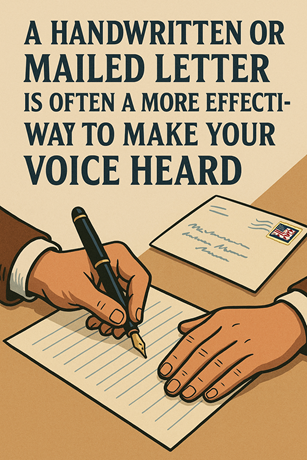
“A handwritten or mailed letter is often a more effective way to make your voice heard. The White House receives 40,000–50,000 emails every day, most of which are reduced to summaries and trend reports. By contrast, a handful of letters—perhaps 10—are chosen for the policymakers’ daily briefing folder.”
1. Be Personal, Not Generic
- Share a personal story or experience that connects to a larger issue.
- Instead of just saying “I oppose higher taxes,” explain how a specific policy impacts you, your family, or your community.
- Staff look for letters that put a human face on a policy.
2. Keep It Clear and Focused
- Stick to one main issue per message.
- Use simple, direct language instead of long explanations.
- Avoid clutter — a focused story or argument is easier for staff to pull and summarize.
3. Connect to National Values
- Relating your concern to American ideals (freedom, fairness, opportunity, the Constitution, the Bible if appropriate for you) makes it resonate more.
- Example: “I believe protecting the Second Amendment is part of protecting the freedoms our nation was founded upon.”
4. Show Respect and Sincerity
- Avoid insults, sarcasm, or angry rants — those are less likely to be passed up the chain.
- A firm but respectful tone has a greater chance of being taken seriously.
5. Be Timely
- Reference a current event, bill, or policy debate.
- Timely messages are more likely to be chosen because they connect with what the President and staff are already discussing that day.
6. Make It Shareable
- Write in a way that makes your message quotable.
- Short, memorable sentences often stand out.
- Example: “When government spending grows, my family’s grocery budget shrinks.”
7. Send It Through the Right Channel
- Use the official White House contact form (https://www.whitehouse.gov/contact/) — this is the fastest way to get into the system.
- For especially important issues, send both an online message and a physical letter (mailed letters often carry extra weight because fewer people take the time to write them).
✨ Pro Tip: If you’re writing on behalf of an organization or church, note how many people you represent. Saying “I’m writing on behalf of 200 families in our congregation” gives the letter more influence than just speaking as one individual.
Let me know what you think below
Copyright Notice © 2025 Cecil Wayne Thorn Permission is hereby granted, free of charge, to any person obtaining a copy of this work authored by Cecil Wayne Thorn, to distribute, display, and reproduce the work, in its entirety, including verbatim copies, provided that no fee is charged for the copies or distribution. This permission is granted for non-commercial distribution only.